Event
BRISA Reading Group 06 - Long-WAM: Scaling the Context of World-Action Models
The sixth reading group of BRISA, the Berlin Robotics & Intelligent Systems Association, held at the Merantix AI Campus to discuss Long-WAM, a paper on how much visual history a world-action model can use for real-time robot control.
- Event
- Robotics
- AI
- World models
- Type
- Event
- Date
- 16 November 2026
- Location
- Berlin, Germany
- Reading time
- 6 min
On 16 November 2026 I attended BRISA Reading Group 06 at the Merantix AI Campus in Berlin. The reading group is run by BRISA, the Berlin Robotics & Intelligent Systems Association, which describes its aim as building the future of physical AI in Berlin. The event page lists BRISA, the Merantix AI Campus and Myron Sydorov, VP at BRISA, as hosts. Doors opened at 18:30, the session started at 18:45 and was planned to end at 20:00. The sixth session was devoted to a single paper: Long-WAM, on how much of the past a robot's world-action model can actually use.
Why I went
World models and robot learning are close to my own field of simulation: a world-action model predicts how a scene will evolve before it acts. A reading group suits the topic well, because it is about one paper and the discussion around it. I also wanted to meet the people working on physical AI in Berlin, exchange ideas and thoughts with them, and find out where my own next steps in this area could lie.
What I saw
The event page explained the problem behind the paper. A robot that only sees the current frame cannot tell whether the cup in front of it is moving, or how far along its task it already is. More visual history looks like the obvious fix, but history costs time, and a robot that thinks too long acts too late.
- The topic World-action models predict how a scene will evolve and act on that prediction, instead of mapping images straight to actions. The session asked how much of the past such a model can use.
- The format No preparation needed, and open to everyone, whatever and wherever they study and however much robotics they have done. Places were limited to keep the session personal and interactive; the page shows 33 registered guests.
- The invitation Guests were asked to bring questions, disagreements, or their own guess at how many seconds of the past a robot should remember.
The paper we discussed
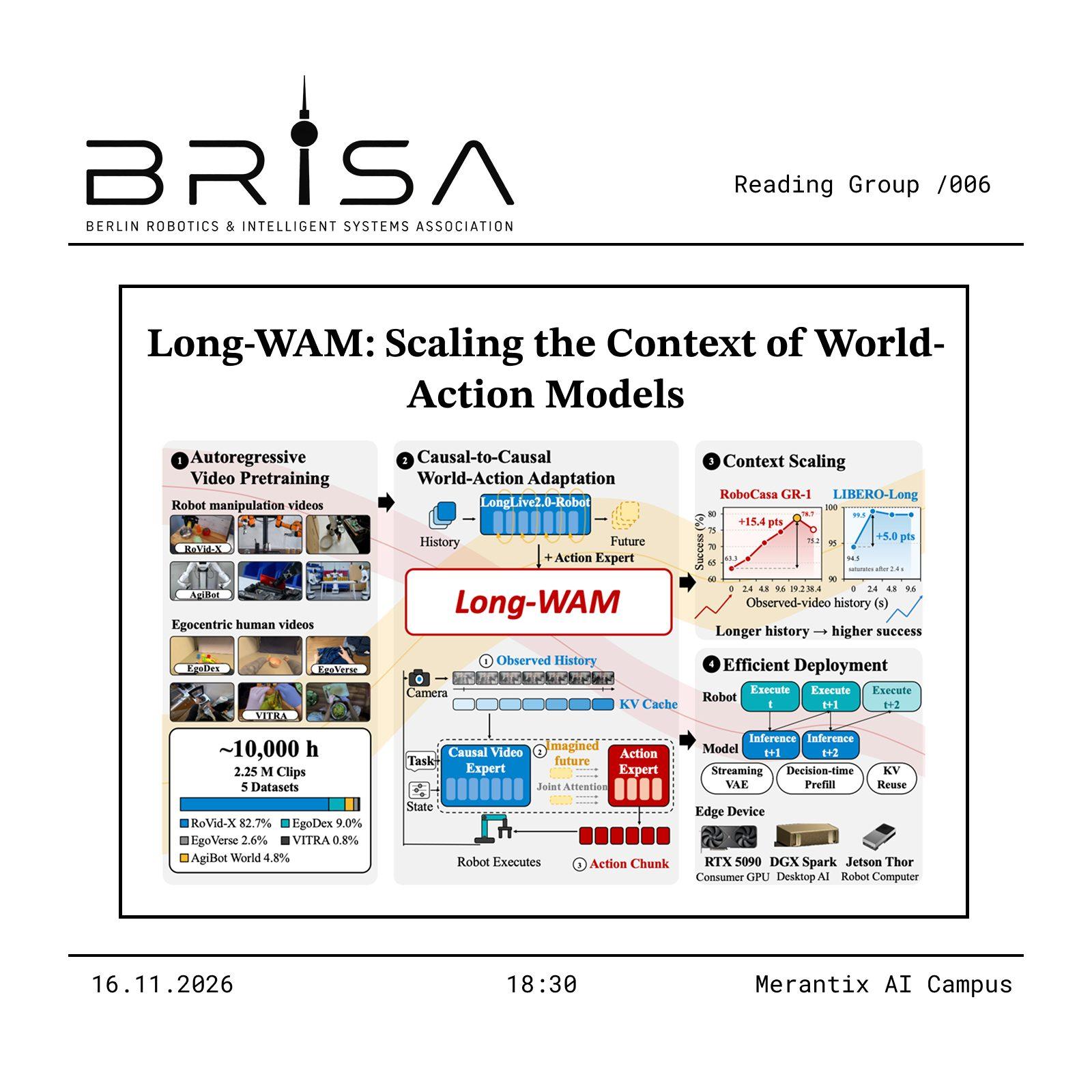
Long-WAM: Scaling the Context of World-Action Models by Wei Huang, Bohan Zhang, Chenzhi Liu, Isabella Liu, Shuai Yang, Weian Mao, Luozhou Wang, Yicheng Xiao, Weifeng Lin, Qixin Hu, Bryan Chu, Sifei Liu, Linxi Fan, Xiaojuan Qi, Song Han and Yukang Chen, from NVIDIA, MIT, HKU and UCSD. It was submitted to arXiv on 7 October 2026, and the code is public.
The question. Real-time robot control needs enough visual history to infer motion and task progress, but processing that history can delay the action. The authors ask how control with a world-action model (WAM) scales with visual context, and how those gains survive real-time constraints.
The method. The paper combines a training recipe with a deployment stack:
- Autoregressive video pretraining LongLive2.0-Robot continues from the LongLive-2.0 video model and learns to predict video from robot and egocentric human footage: about 10,000 window-equivalent hours from five dataset families, sequences of up to 30 seconds, no action labels.
- Causal-to-causal adaptation A video expert and an action expert are coupled so that video tokens only attend to current and earlier video, never to actions. At inference the model first predicts future latents in four denoising steps, never decodes them to pixels, and then denoises an action chunk conditioned on the observed history and that predicted future.
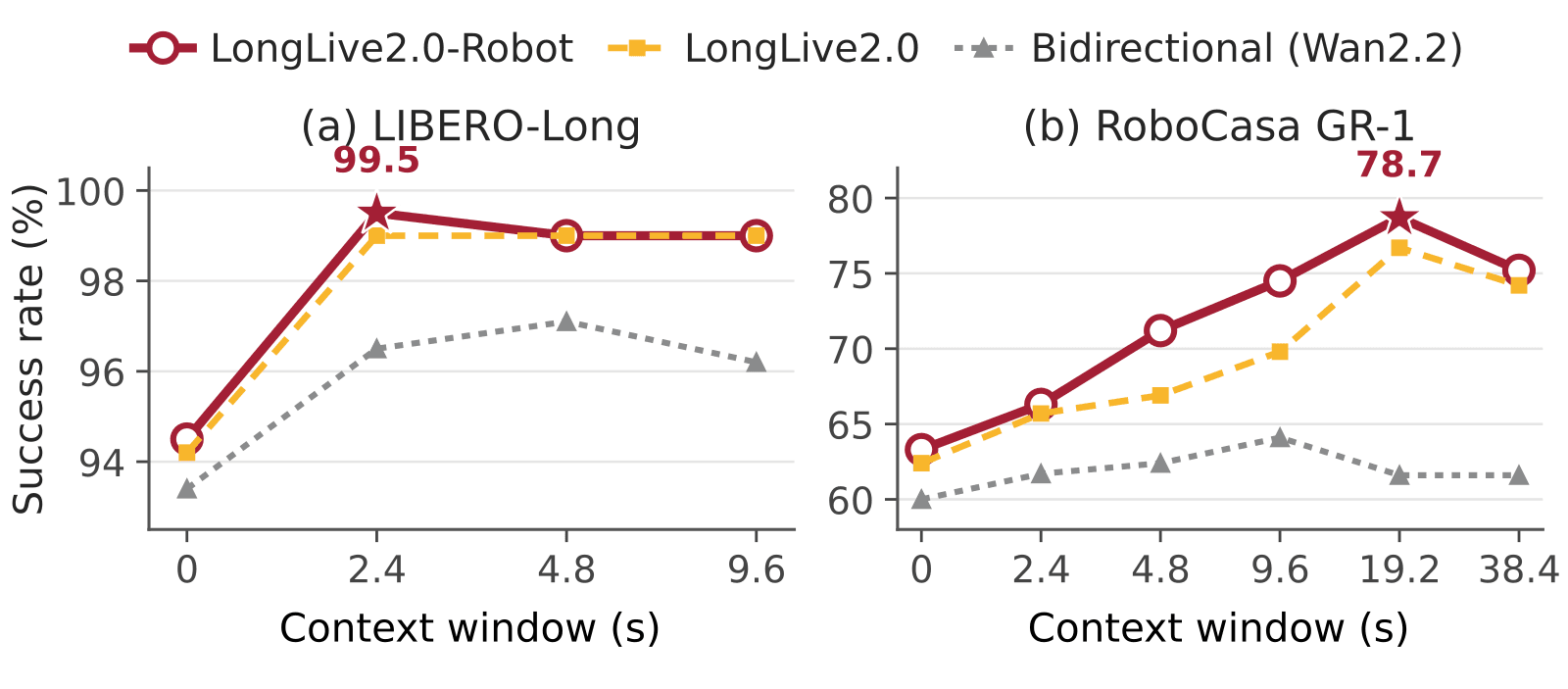
- Context scaling The length of real history is varied (0 to 38.4 seconds on RoboCasa GR-1, 0 to 9.6 seconds on LIBERO-Long) with forecast and action horizon fixed, one separately trained model per window. Three starting points are compared: Wan2.2 (bidirectional pretraining), LongLive-2.0 and LongLive2.0-Robot (both autoregressive).
- Real-time deployment Asynchronous execution overlaps inference with robot motion, a streaming VAE encodes frames as they arrive, and 4-bit NVFP4 quantisation of the video expert, CUDA Graphs, KV reuse and per-device kernel tuning speed up inference on an RTX 5090, a DGX Spark and a Jetson AGX Thor.
The results, as the paper reports them:
- Context needs the right pretraining On RoboCasa GR-1, going from 0 to 19.2 seconds of history raises success from 63.3% to 78.7%. The bidirectionally pretrained start shows no net gain, so its gap to the robot-domain model grows from 3.3 points without history to 17.1 points. On LIBERO-Long, 2.4 seconds of history lift success from 94.5% to 99.5%. The authors offer a plausible explanation, not a proof: autoregressive pretraining already learns the history-to-future structure that the action model keeps.
- Benchmarks 99.5% average on LIBERO, 94.4% on RoboTwin 2.0 and 34.9% on DOMINO with moving objects, the highest among the methods compared. The 78.7% on GR-1 is 11.6 points above the strongest baseline in the paper. Paired with a high-level planner on RoboCasa365, overall success rises from 31.4% to 54.4%, against 25.2% for the planner alone.
- Speed One action chunk, including the future prediction, takes 107.4 ms on an RTX 5090, 3.3 times faster than unoptimised BF16; DGX Spark reaches 328.2 ms and Jetson AGX Thor 378.7 ms. Under asynchronous execution, success on RoboTwin 2.0 drops by 0.2 points, against 15.4 for Fast-WAM and 45.5 for LingBot-VA.
- Real robots On a Unitree G1, grasping cups from a conveyor stays at 90 to 100% at belt speeds from 3.0 to 7.5 cm/s, where Fast-WAM falls from 75% to 0% and π0.5 from 15% to 0%. Stacking a moving cup works in 19 of 20 trials; neither baseline succeeds once. On a YAM bimanual arm, tasks lasting over 40 seconds on average succeed in 81.7% of trials.
The limitations the authors state:
- Each context window is its own trained model. A single policy that adapts its window at test time is named as the next step.
- History has a price: going from 2.4 to 19.2 seconds raises latency on the RTX 5090 from 107.4 to 341.0 ms (74.6 ms without history).
- At 38.4 seconds, success falls back to 75.2%. That window is three times the average training trajectory of 12.1 seconds, and 80.4% of its history frames are padding; the authors suspect missing data rather than a memory limit.
- The context study runs in simulation; real-robot context studies are still to come. The trends do not imply a power law or a fixed optimal window.
- The 10,000 hours are a window-equivalent estimate, not unique footage, and transfer to an unseen robot body would need its own evaluation.
What I take from it
Above all, the evening deepened my understanding of a technology: world-action models and the trade-off between how much history a robot uses and how fast it can act. That more context only pays off with the right pretraining, and that every extra second of history costs latency, is something I take with me. I also extended my network in Berlin's robotics community.
Keep reading
See all posts- Event · 13 November 2026 · Berlin, Germany
Unicon 2026: startup and AI conference at CODE in Berlin
Unicon 2026 was a two-day, curated startup and AI conference for around 300 students, founders and investors, hosted at CODE University of Applied Sciences in Berlin-Neukölln on 13 and 14 November 2026.
- Event · 17 November 2026 · Berlin, Germany
GTM Engineering Meetup: Agents in Production
An evening meetup during GTM Tech Week Berlin with talks and live demos on AI agents that run in everyday go-to-market work.